Jean-Thomas Tremblay
Scholar of literature, film, ecology, and sexuality

Jean-Thomas Tremblay (PhD, English Language and Literature, University of Chicago, 2018) is an Associate Professor of English at York University. He holds graduate appointments in English, Film, Science & Technology Studies, and Social & Political Thought, where he previously served as Graduate Program Director. In 2025, Tremblay received the Liberal Arts & Professional Studies Dean’s Award for Distinction in Research, Creativity, or Scholarship—Emerging Researcher.Spanning literary studies (especially modern and contemporary U.S. and Anglophone prose), film studies, the environmental humanities, and sexuality studies, Jean-Thomas Tremblay's research and teaching bring aesthetic modes of attention to conceptual and historical questions pertaining to overlapping environmental, economic, and political crises in settler and extractive societies. His current research draws on psychoanalysis and deconstruction—as they have been taken up in queer theory and Afropessimism—to consider the climate crisis as a problem of language.Tremblay is the author of Breathing Aesthetics (Duke University Press, 2022); a co-author, with Steven Swarbrick, of Negative Life: The Cinema of Extinction, (“Superimpositions: Philosophy and the Moving Image” series, Northwestern University Press, 2024), which earned the Honourable Mention for the 2025 Association for the Study of the Arts of the Present Book Prize and was shortlisted for the 2025 Ecocritical Book Award of the Association for the Study of Literature and the Environment; and a co-editor, with Andrew Strombeck, of Avant-Gardes in Crisis: Art and Politics in the Long 1970s, coedited with Andrew Strombeck, State University of New York Press, 2021).Tremblay’s monograph-in-progress, funded by the Social Sciences and Humanities Research Council of Canada and tentatively titled “The Climate after the Fact,” regards ascendent ways of reading the climate, both within and beyond ecocriticism, as symptomatic of late liberalism. Occupying such contexts as diplomacy, whistleblowing, and sabotage, the book models an illiberal climate thought that would prevent the Gaia hypothesis from collapsing onto itself tautologically, with the Earth-as-world communicating to us our rightful and righteous place in the self-regulation of a superorganism’s biotic and abiotic components. Excerpts from this project have appeared in Critical Inquiry, Representations, and differences.Tremblay is a member of the Advisory Board of differences: A Journal of Feminist Cultural Studies and a Contributing Editor to Discourse: Journal for Theoretical Studies in Media and Culture.Please refer to Jean-Thomas Tremblay's institutional page for additional information.
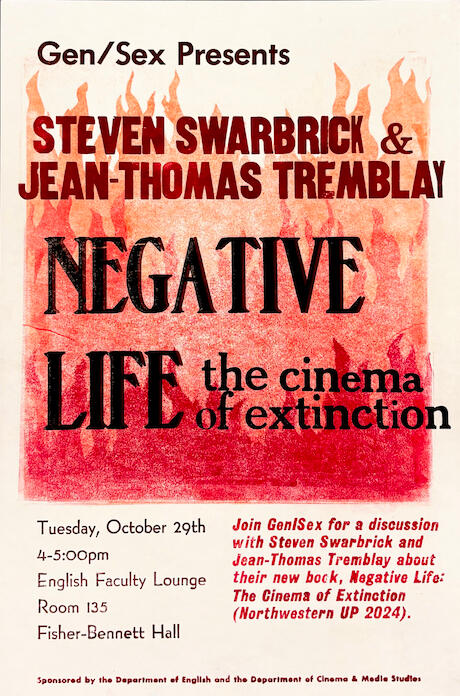
Poster design by Austin Svedjan
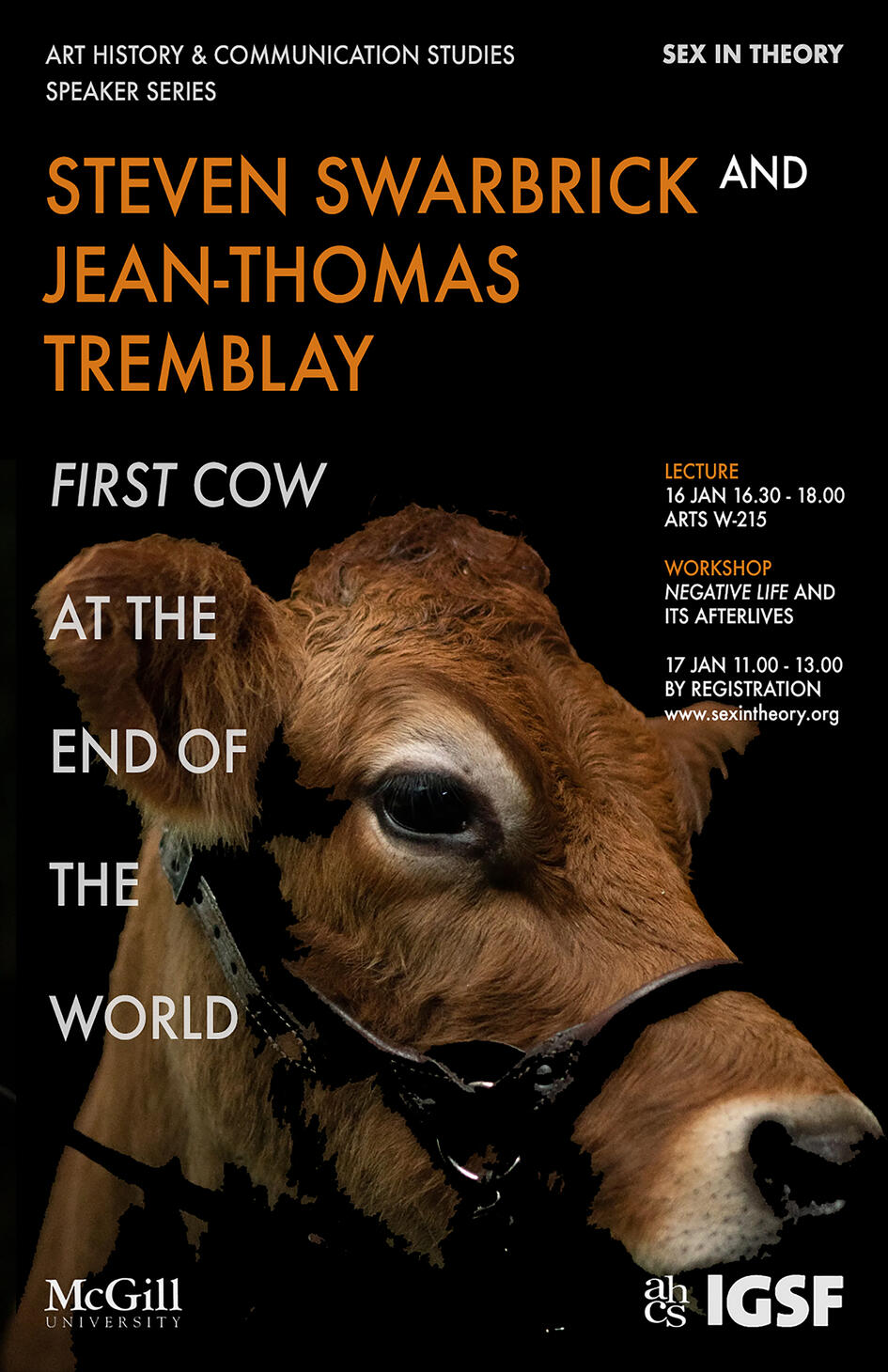
Poster design by Bobby Benedicto